Academic
Validation
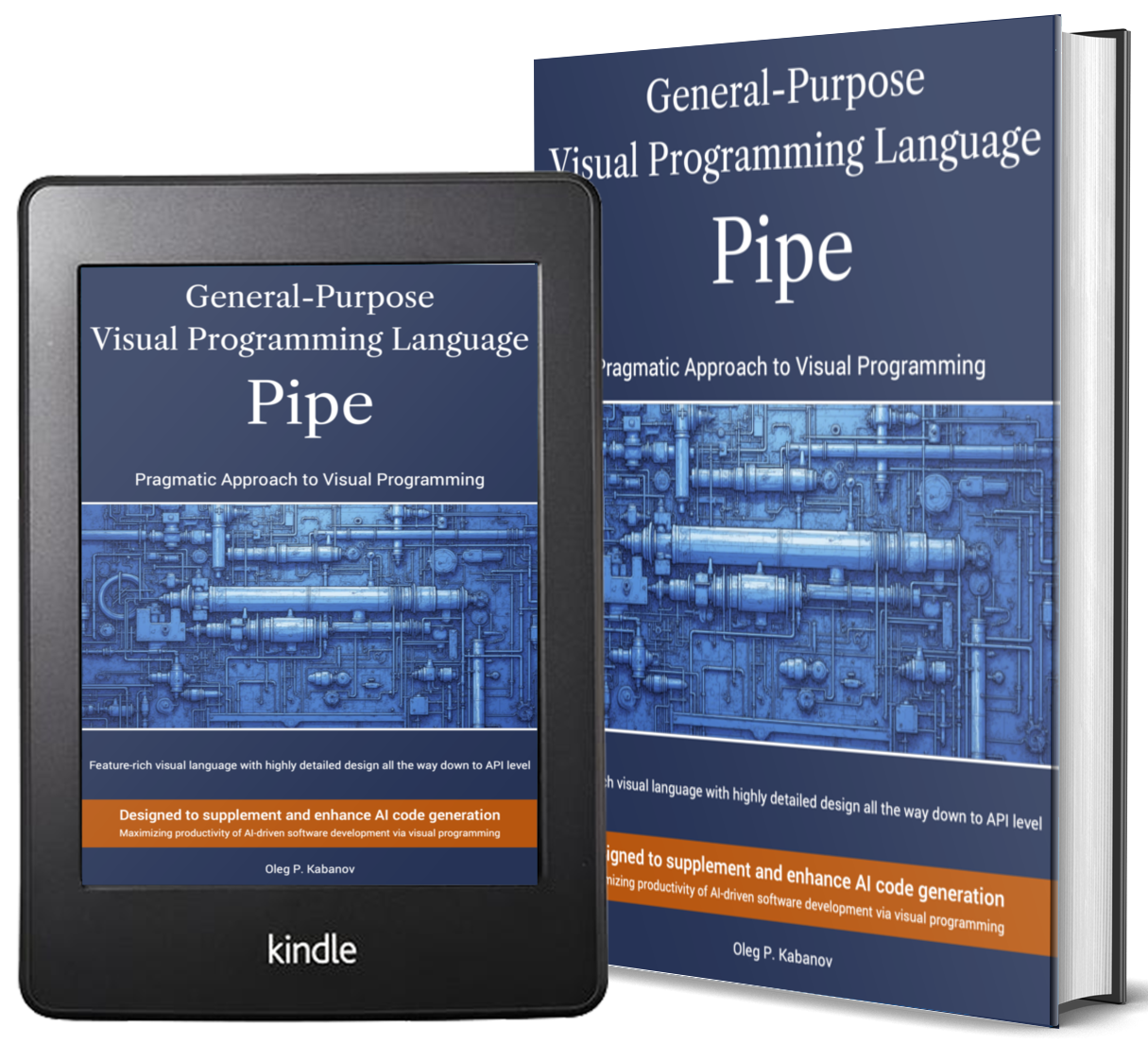
Now live: the Pipe IDE runs right in your browser — build, run, and visually debug your programs, no install needed.
AI-ready: download the book PDF and upload it to any LLM to interrogate it — ask questions, explore details, or extract outputs tailored to your needs.
Frequently Asked Questions
To some extent, yes — but the transition is far less disruptive than it sounds:
- The migration is gradual — you don't have to discard all existing code at once. You start by wrapping your entire project in a single top-level block. That's the initial step. Then, whenever you're ready, you add a workflow inside that top-level block and distribute the code across the visual blocks of the newly created workflow — and you can keep going, level by level.
- You choose how far to go. You can stop subdividing blocks at any point, so it's entirely your decision which parts of the system become visual and which remain as text.
- Pipe makes integration easy. It provides a simple bridge for connecting visual blocks to your existing text code.
- AI reduces the overhead of going visual. AI can generate diagram layouts from your existing code, update them as the code changes, suggest how to partition logic across blocks, and flag structural issues as your model grows.
Every technology advances in a spiral — it fails several times before its lessons are learned and it finally succeeds. Pipe was built by studying exactly why earlier visual languages fell short. Two lessons in particular shaped it:
- A visual language must be both general-purpose and semantically powerful to compete with text. Text-based languages dominate precisely because they have both qualities; any visual language that lacks either will fail. Pipe has both.
- The answer isn't to swing between extremes. We tried pure visual programming, it didn't work, so we went back to text-only — which has its own problems, now made obvious by AI. Good engineering doesn't jump between extremes; it finds a synthesis that keeps the strengths of each while minimizing their weaknesses. That's Pipe's core philosophy: it doesn't replace text-based languages — it complements them. In practice, that means the developer decides what goes into visual diagrams and what stays as text.
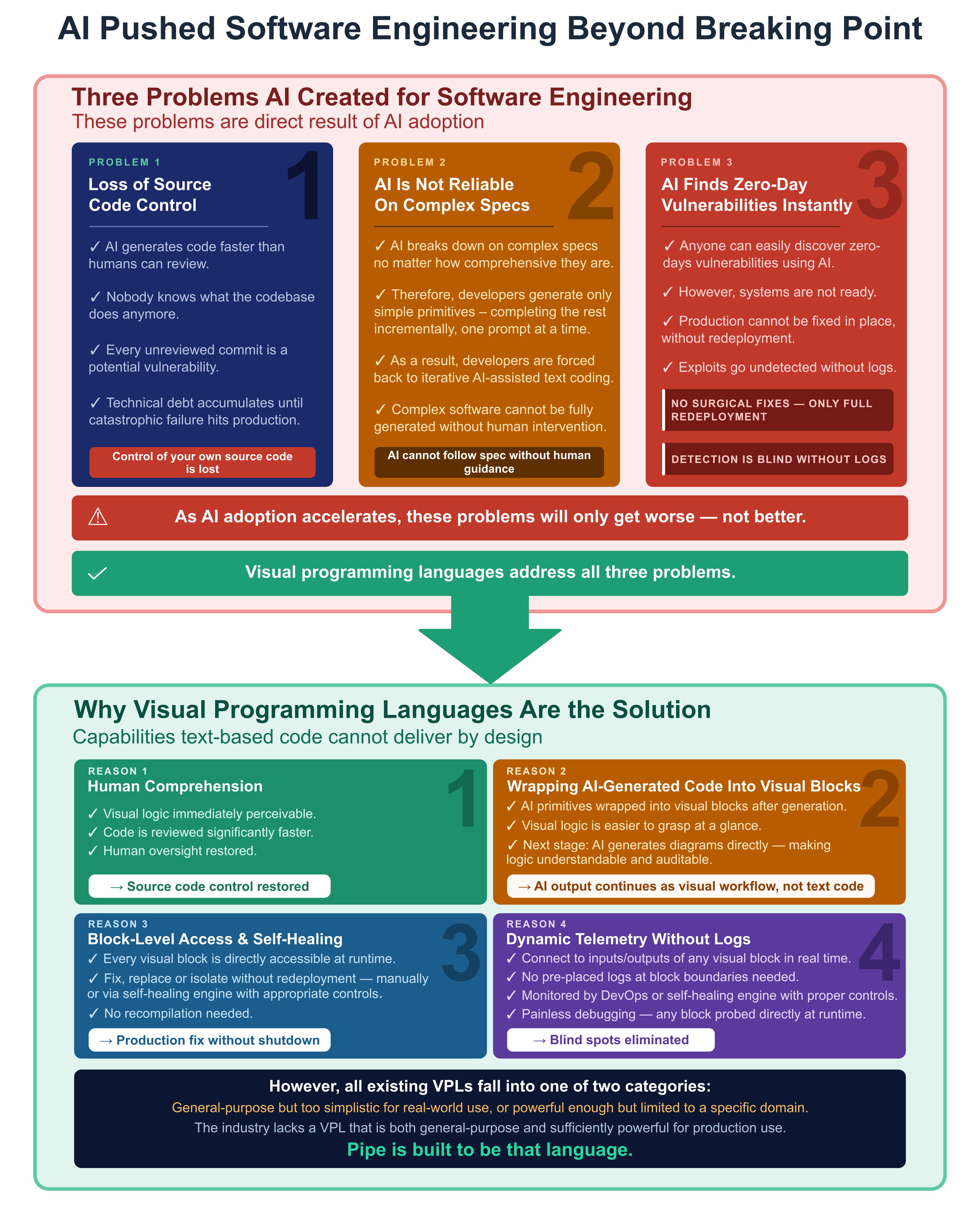
The need for visual programming has become especially clear now that we're building with AI, which has introduced several serious problems that appear unrelated — yet visual programming addresses all of them at the root:
- Cybersecurity. AI makes it far easier for anyone to find and exploit vulnerabilities, so threats are growing. Because Pipe is semantically powerful enough to keep the entire program as a live visual graph in production rather than compiling it into a single opaque artifact, every block in an application stays directly accessible. That access solves two long-standing problems at once: slow patching, by swapping, disabling, or rerouting a faulty block in place instead of waiting on a full CI/CD deployment; and partially-blind monitoring, by tapping the inputs and outputs of any or all blocks directly, so telemetry no longer depends on log statements that may be missing where you need them in source code. The EU Cyber Resilience Act's core demands map directly onto these capabilities — independent confirmation this approach is where regulation is heading.
- Code review. AI writes code faster than developers can review it, and leaning on AI to review AI doesn't fix the root problem — that AI can hallucinate too, so human eyes are still required. Visual programming gives those eyes a far clearer representation of the logic to review. AI-introduced errors are already piling up in production code — one study found nearly a quarter survive for months as silent technical debt.
- AI predictability and customization. Instead of relying on one unpredictable, hard-to-customize model — which can only be changed through costly, time-consuming retraining — you can split it into small, specialized, and therefore more predictable agents, then build an explicitly programmed orchestration layer on top to coordinate them. Customization then happens through that orchestration layer, and visual programming is a far more user-friendly way to do it. This shift is already underway — specialized models like TypeSafe's Jev are built for exactly this kind of orchestration.
Most new languages start with an implementation. For visual languages, that software-first path is exactly what traps them in a single domain and keeps them from ever becoming general-purpose. I did the opposite and specified the full language first; the software is what I'm actively building now.
- It avoids both failure modes. Software-first visual languages get stuck in their first implementation's domain, while purely theoretical ones get buried in complexity — too intricate and incomplete to be practical. Pipe takes the middle ground: well-chosen, practical primitives within a complete, coherent architecture.
- The book's subtitle says it best — "A Pragmatic Approach to Visual Programming." It rests on seven years of R&D but stays in the practical lane, and the result is a consistent, usable, end-to-end visual language.
Accepted into AltaLab — AltaIR Capital's AI Founder Program

Accepted into LvlUp Labs — LvlUp Ventures' Startup Accelerator
One Language, Any Domain
From cybersecurity and development tools to robotics and IoT, Pipe adapts to almost any field - because a truly general-purpose language has no boundaries.
Cybersecurity
Comprehensive observation and real-time patching
In most systems, once code ships to production it turns into a black box – you infer what happened from logs placed in only some parts of the code, and any fix means redeploying the whole system. Pipe is semantically powerful enough to keep the visual graph live in production, with direct access to every block. Instead of relying on logs, monitoring tools can tap the inputs and outputs of any block for comprehensive, real-time observability into exactly what the system is doing. And when something needs to change, you can patch in place – replacing, rerouting, or disabling individual blocks without redeployment. Threats are seen and contained in minutes, not release cycles. The EU Cyber Resilience Act validates these capabilities.
Development Tools
From AI-generated wall of code to user-friendly visual logic
AI now generates code faster than any team can review it. Overwhelmed by the volume, developers start approving on autopilot – and every unreviewed commit carries hallucinations no one caught, while giving the review to another AI doesn't help – it hallucinates too. In text code, those errors are hard to spot and easy to wave through, so they accumulate silently, commit after commit, until they surface as catastrophic failures in production. Pipe makes logic visual and reviewable at a glance, so a whole change can be understood in seconds instead of picked through line by line – letting human oversight keep pace with AI, and catching errors before they ship rather than after they break. It's not hypothetical — studies already document the accumulating damage.
Robotics and IoT
Making AI predictable and customizable
Robots and IoT devices increasingly run on AI models – and AI is probabilistic by nature, so the same input can produce different behavior. Model's parameters can't be edited directly, so the only way to modify its behavior is costly retraining that changes many aspects of what it already learned. The fix is to split one large model into many small, predictable, testable ones. But small models need an orchestration layer to work together – and that layer is normally written in text code, which means customizing behavior through user-unfriendly text changes. Pipe is powerful enough to replace text code, so it orchestrates the small models visually instead – a user-friendly way to customize behavior without retraining. Models like TypeSafe's Jev confirm this shift.
Why Language Pipe Is Different
Visual programming language Pipe provides many powerful features.
Open visual language
Developers can create or modify visual components exactly to their requirements and specifications.
General-purpose visual language
Pipe contains only general-purpose elements not limited to narrow domain-specific concepts.
Compact & powerful language
Pipe provides relatively few elements and concepts still allowing implemenation of complex algorithms.
Complete & detailed specification
Complete and detailed language specification allows building entire virtual machine for Pipe flowchart execution.
Practical visual language
Pipe does not replace non-visual programming languages but rather complements them.
API for non-visual languages
Complete API specification is provided for integration with non-visual programming languages.
Statically-typed language
Pipe is a statically-typed visual language similar to top-tier non-visual programming languages.
Multiple levels of usage
No need to know the full Pipe specification to start development using visual language Pipe.
Integration with AI code generation
Pipe can play a role of an integration layer for AI-generated code converted into visual components.
Dynamic Runtime Execution
Every visual block stays directly accessible and modifiable at runtime, with no recompilation needed.
Low-code platforms
Using Pipe for visual integration of AI-generated components can inspire the next generation of low-code platforms.
Long-term vision
There are tons of new ideas and features already planned for future versions of Pipe language.
Patent Pending
Multiple patent applications related to visual language Pipe have been filed.